

“I’m writing a book.” — “Neither am I.” Peter Cook famously coined that joke. He was a master of comedy and utterly brilliant at carefully crafting English into fabulously funny entertainment.
I chose this title because it’s evocative. The original title was “How I write”, which is pretty anodyne; and the second choice “Writing is hard; and shouldn’t be” sounds like the preamble to a confessional about how unfair life is.
This essay was prompted by strongly positive feedback about how my writing has improved. I’m more focused and write with greater clarity than I once did.
Writing is easy. Good writing is hard. The unlock for me has been recognizing that I move through a series of distinct steps to get from idea → communicated content.
That realization gave rise to this essay: how could I make it interesting to write about how I use AI to write about AI? (Yes, that’s a little facetious, but it makes me smile, and reminds me of another master of comedy, Terry Pratchett.)
After all, this isn’t about using a tool. It’s about how tools support different modes of thinking. When ideating, I use a divergent-thinking model where precision is actually undesirable. When writing, I shift to convergent thinking, turning ideas into precisely crafted content.
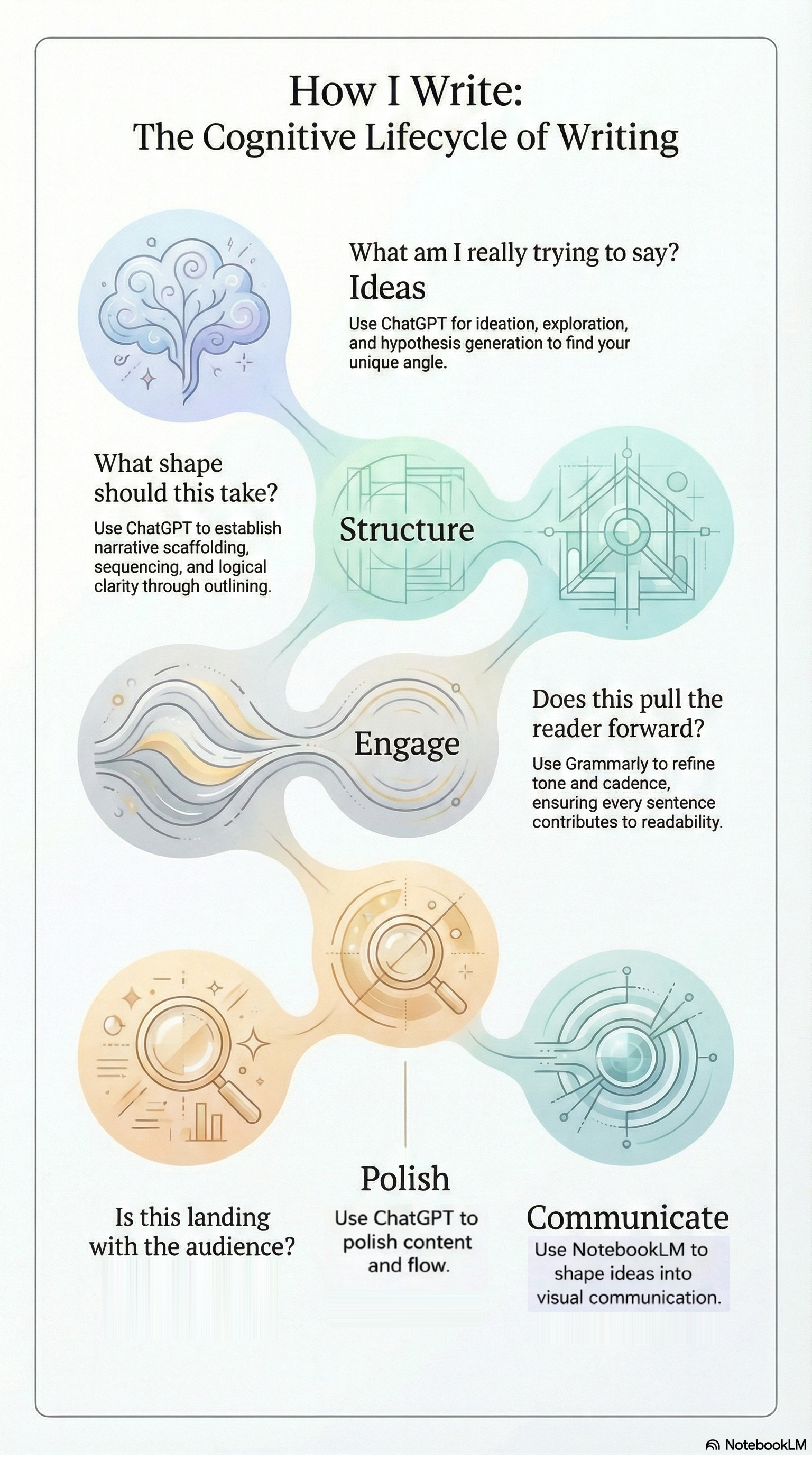
In short, as the image states, I:
Start with an idea and discuss it with ChatGPT to see if there’s any “there” there. We call this ideation, but it’s simply batting an idea backwards and forwards to test whether it’s interesting.
Then I ask ChatGPT to propose a structure. Bullet points are fine. The tool supports my thinking; it must not replace my voice.
The third step is the writing. I copy/paste the bullets into Grammarly and begin drafting. Grammarly helps keep sentences clear and readable.
Fourth comes polishing. I copy my draft back into ChatGPT and ask, “Please review for content, flow, and clarity.” I respond to that feedback by tightening, reshuffling, and refining the text in Grammarly.
When I’m satisfied, it’s time for communication. Once upon a time, I would simply post to Substack and trim for LinkedIn. But thoughtful communication asks a different question: who is this for, and how should it land? More simply: how can I get people to engage? For this, I use NotebookLM - the image for this article was generated by it.
This piece anchors a three-part series. Article 2 walks through the prompts I use and why. The final article explores reflections and guardrails: what works, what doesn’t, and why.