
The most important part of your work evaporates
Working Knowledge — a three-part series on expertise, institutional memory, and the IP problem nobody's treating like one.

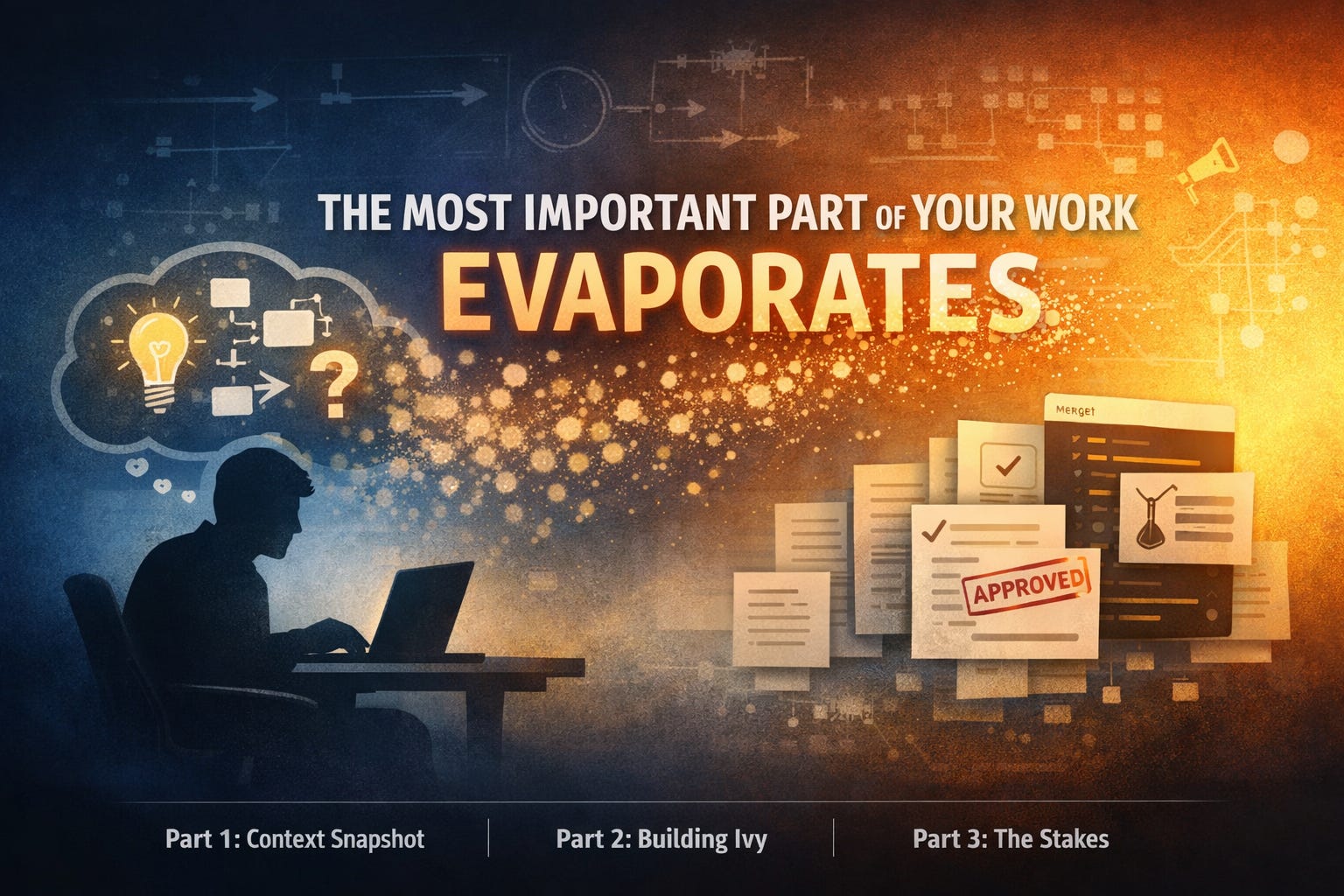
You make decisions all day. You pattern-match against years of experience. You know exactly why the last three approaches didn’t work — and why this one might.
None of that is in the record.
What gets captured is the output. The recommendation. The merged PR. The approved proposal. The reasoning that produced it — the tradeoffs weighed, the alternatives rejected, the judgment calls that shaped the outcome — stays in your head until it fades.
This isn’t a documentation problem. It’s an intellectual property problem — and it’s one we need to resolve.
The practitioners who build lasting leverage aren’t just doing good work. They’re converting how they think into something the organization can find, rely on, and build from. Reasoning becomes institutional memory. Institutional memory becomes IP.
Most of that conversion isn’t happening — and the cost is invisible until someone leaves, a project closes, or a decision gets made again from scratch.
This week’s three-article series explores this. Built from practice, shared in public.
Part 1 — Context Snapshot. The practice. Lightweight, immediate, yours. How to start capturing the reasoning behind your work — not the output, the thinking.
Part 2 — Ivy. The system I built around it. Local-first, owned, structured. Expertise that persists — structured, portable, open, agnostic.
Part 3 — The Stakes. This is bigger than productivity. What changes now is what’s possible when you bake your judgment into the infrastructure — and what it costs when you don’t.