

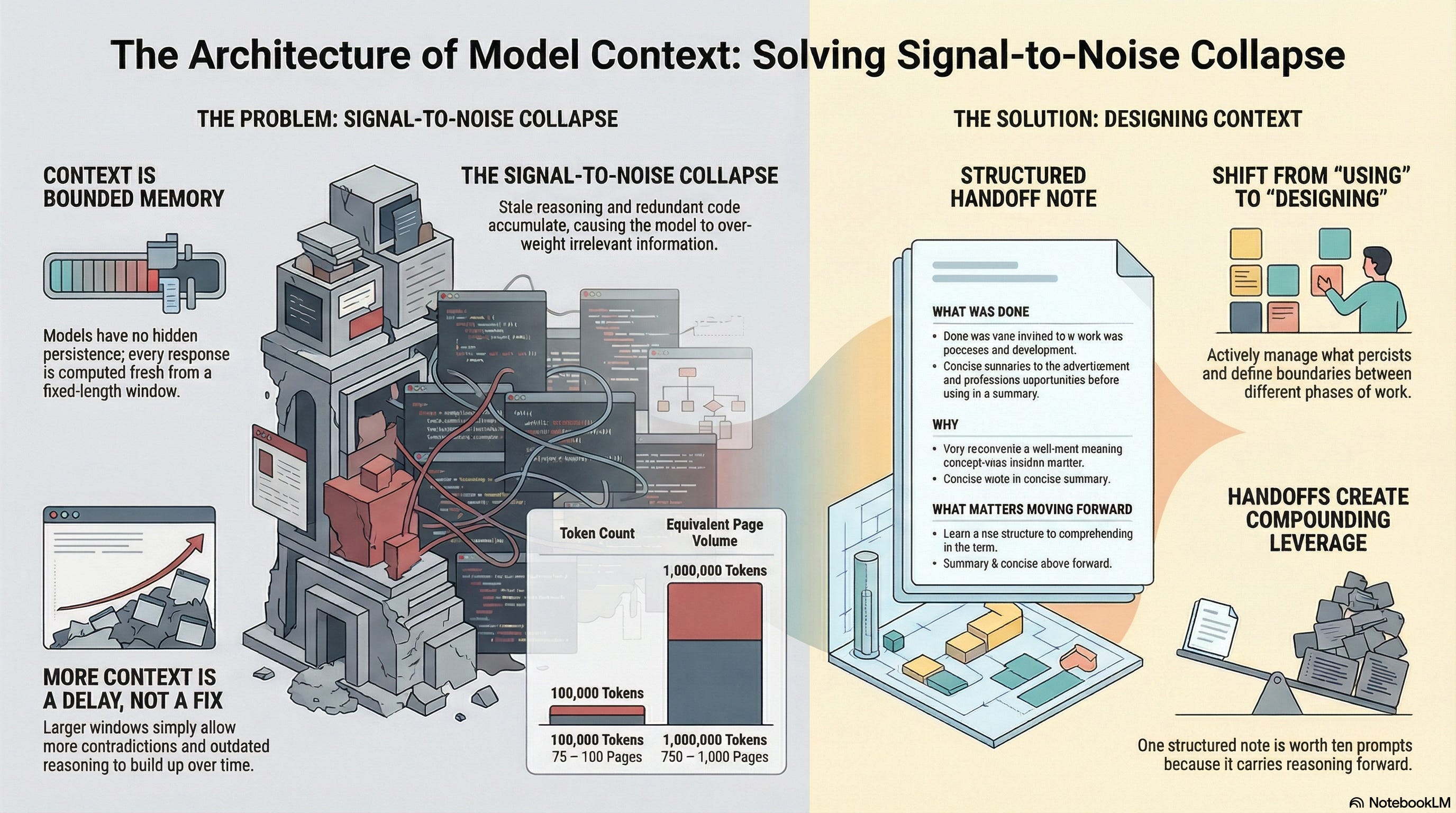
The main piece tells you what to do. This one explains why it works — what’s actually happening inside the model when a session starts to fall apart, and why the fixes are structural rather than cosmetic.
The Misunderstanding
When an AI session starts to degrade, most people reach for the wrong explanation:
“The model got worse.”
“This one isn’t as good.”
“Something broke.”
That’s almost never what’s happening.
What’s actually happening is simpler — and more uncomfortable: the model is doing exactly what you told it to do, given the context you gave it.
The problem is that the context has degraded.
What a Context Window Actually Is
A context window is the bounded working memory of the model — everything it can “see” at once:
Your prompts.
Its responses.
Any pasted code, logs, or data.
Modern models operate over a fixed-length sequence of tokens. No hidden memory. No persistence. Every response is computed fresh from whatever fits in that window.
A useful translation:
1 token ≈ ~0.75 words
100,000 tokens ≈ ~75–100 pages
1,000,000 tokens ≈ ~750–1,000 pages
That sounds large. It isn’t.
A few debugging loops can burn through that surprisingly quickly — especially in analytics workflows where schemas are verbose, transformations are long, errors include full stack traces, and code gets pasted repeatedly. The effective capacity is far smaller than the theoretical limit.
Why Debugging Breaks Context So Fast
Debugging has a specific shape:
Introduce an error
Get a suggestion
Modify code
Re-run and paste output
Revise approach
Each loop adds new tokens, overlapping code, and partially outdated reasoning.
Here’s the key constraint: the model cannot delete earlier reasoning. It can only compete with it.
So, over time, stale assumptions remain, new reasoning builds on them, and contradictions accumulate. That’s when drift starts.
The Real Failure Mode
The failure mode is not “running out of tokens.” It is a signal-to-noise collapse inside the window.
Once enough irrelevant or outdated context accumulates, the model over-weights the wrong information, misses constraints you already established, and repeats prior mistakes.
At that point, adding more context makes things worse.
Why “More Context” Doesn’t Save You
There’s a natural instinct: if context is the issue, just get more of it. Switch to a larger context window.
This doesn’t fix the problem. It delays it.
A larger window just allows more stale reasoning, more duplication, and more contradictions to accumulate. The underlying issue remains:
You are accumulating unstructured context faster than you are managing it.
The Shift: Context Is Something You Design
The turning point is recognizing this:
Context isn’t something you use. It’s something you design.
That design shows up in how you structure phases of work, define boundaries, and decide what persists and what doesn’t.
This leads to the most underused artifact in AI-assisted development: The handoff note.
The Handoff Note Is A Best Practice
A handoff note is a structured summary of:
what was done
why it was done
what remains
what matters going forward
Most people treat this as disposable. It isn’t. It is the bridge between contexts.
And it has value well beyond the chat session. You can — and should — embed it directly into your workflow:
Commit message — captures intent alongside code
Pull request description — explains decisions to reviewers
Inline comment or attached doc — preserves reasoning at the right level of detail
Standalone document — builds a reusable corpus of thinking
Each of these turns ephemeral reasoning into something durable. The value isn’t just that you solved the problem. It’s that someone else — or future you — can now understand how and why.
Why This Compounds
In a world where code is increasingly instant, the bottleneck shifts. Not writing code, but understanding it. Not generating solutions, but reasoning about them.
A single well-structured handoff note is worth more than ten well-written prompts, because it carries reasoning forward rather than starting over. Over time, structured handoffs create a trail of decisions, a map of reasoning, a body of work others can build on.
That’s where leverage lives.
The Practical Takeaway
Treat the context window like a constrained system. It:
Fills faster than you expect.
Degrades before it breaks.
Cannot clean itself.
Treat the handoff note like a first-class artifact. It:
Preserves signal.
Enables continuity.
Creates leverage beyond you.
The principle: You don’t get leverage from AI by producing more. You gain leverage by making what you produce usable for others and for your future self.
Context is where that starts. Handoff is how it persists.