
Turning Reading Into Leverage With NotebookLM
How I use AI tools to turn a single article into shareable, domain-relevant insight

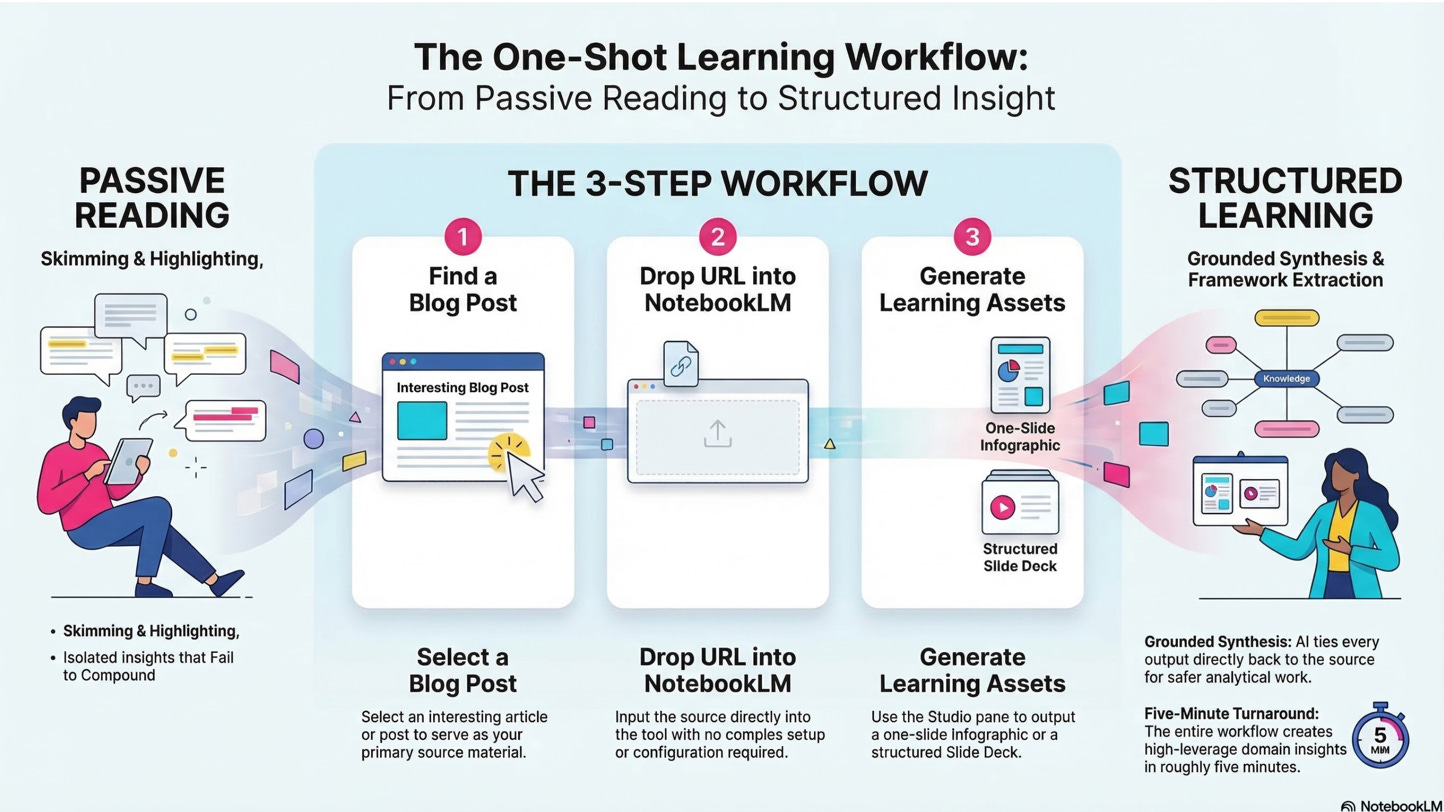
Part 1: One-Shot Learning From a Blog Post
Most of us read the same way we always have.
We skim a blog post.
Maybe highlight a few lines.
Possibly save it to a notes app.
Then we move on.
The problem is that the insight never compounds. The article stays where it started: a single piece of reading, isolated from the rest of our thinking.
More tragically, it’s disconnected from the rest of the team
Recently, I’ve been experimenting with a different approach: using AI tools to turn reading into something closer to structured learning.
This post is the first in a short three-part series exploring that workflow.
The goal is simple:
Turn one piece of reading into high-leverage domain-relevant insight using AI tools.
I write about how AI tools are changing the way technical teams learn, build, and reason about complex systems.
The Three Experiments
Across this series, I’ll run the same basic experiment three ways.
Experiment 1 — One-Shot Learning (This Post)
Take a single blog post and drop it into NotebookLM.
The key point: no complex setup. One source → one destination
This is the fastest possible path from reading to structured insight.
Experiment 2 — Deep Synthesis
Next, we’ll repeat the process with a whitepaper instead of a blog post.
Whitepapers are denser.
They contain claims, frameworks, and assumptions.
NotebookLM is particularly strong here because it can:
map claims to specific passages
trace ideas across long documents
generate structured summaries
The goal of this experiment is to see how well NotebookLM performs on serious conceptual material, not just blog posts.
Experiment 3 — Tool Chaining
Finally, we’ll add another layer.
We’ll use the same whitepaper and feed it into ChatGPT, with a carefully crafted prompt that reflects my work in analytics and AI systems.
Then we’ll move that prompt output into NotebookLM.
In other words:
Whitepaper → Claude prompt → NotebookLM analysis
This lets us test something powerful:
What happens when you chain AI tools together intentionally?
Why This Matters
There are three reasons this workflow is interesting.
1. NotebookLM Is Extremely Good At Structured Reading
NotebookLM excels at something that’s surprisingly hard for most AI tools: grounded synthesis.
It doesn’t just summarize — it ties its output directly to the source.
That makes analytical work much safer - no hallucinations.
2. AI Tools Compound When You Chain Them
A single AI tool is useful.
But the real leverage comes from combining them.
Each tool has strengths:
ChatGPT excels at reasoning and prompt-driven analysis.
NotebookLM excels at source-grounded synthesis.
Other tools excel at visualization or publication.
When you intentionally combine them, the output becomes more powerful than any single tool.
3. Judgment Is Still The Multiplier
The most important step in this workflow isn’t the AI, but the questions you ask.
Two people can feed the same article into NotebookLM and get completely different value out of it.
The difference is judgment:
What do you ask?
What connections do you look for?
What domain context do you bring?
AI accelerates thinking, but it doesn’t replace the thinker.
The One-Shot, Three-Step Workflow

Here’s the simplest possible version of the workflow.
Step 1
Find a blog post that’s interesting.
This series of articles began with this blog post by a colleague.
Step 2
Drop the URL into NotebookLM.
Step 3
From the “Studio” pane, generate the output - I typically choose
InfoGraphic for a single-slide summary of it all
Slide Deck for some more structured learning
That’s it
Capture the output and refine it.
The entire process takes about five minutes.
But instead of passive reading, you now have:
a structured summary
a framework extraction
This is how we start moving from reading to structured learning.
Coming Next
In the next post, we’ll raise the difficulty level.
Instead of a blog post, we’ll use a full white paper to assess how NotebookLM handles more complex conceptual material.
Then, in the final post, we’ll introduce tool chaining with Claude.
By the end of the series, the goal is to show something simple:
AI can turn reading into a high-leverage activity — if you use it intentionally.