
Non-Linear Learning With AI
How tools like NotebookLM turn dense documents into navigable ideas

Opening
For most of modern history, reading has been a fundamentally linear activity.
Start at the beginning of a document.
Work through it section by section.
Eventually, if the material is good and you’re patient, the ideas emerge.
That model made sense when the only tool we had for processing information was our own attention.
But AI changes the mechanics of how we interact with written information. Instead of consuming documents sequentially, we can explore them non-linearly.
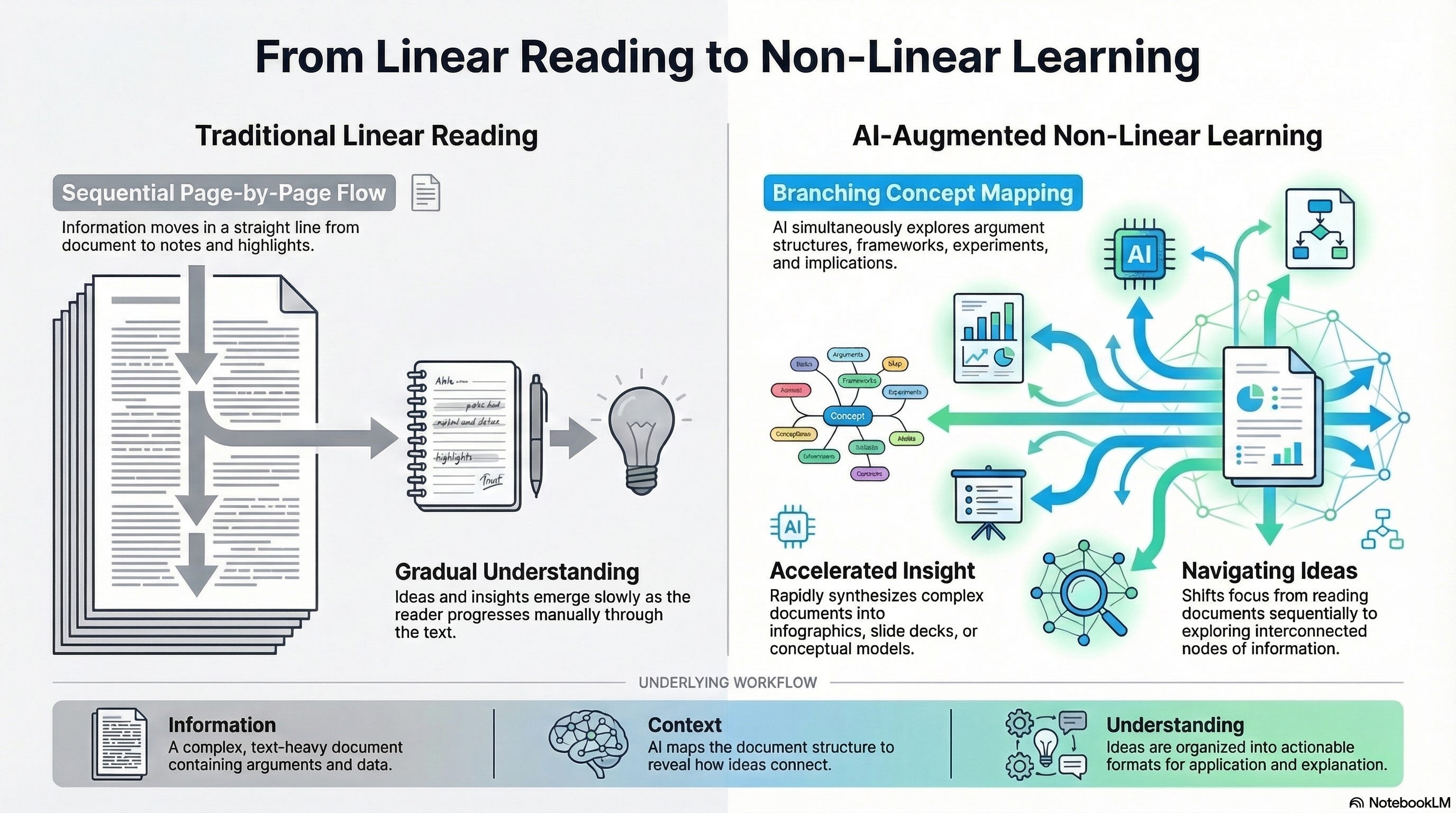
We can jump directly to:
the structure of the argument
the conceptual framework
the implications of the ideas
AI turns documents from things we read into things we navigate.
And when we do that, we unlock something much more powerful: high-leverage learning.
AI doesn’t just help us read faster.
It lets us learn differently.
But what does that actually look like in practice?
What happens if you take a dense research paper and explore it non-linearly?
The Example: A Paper About AI and Human Reasoning
To illustrate the workflow, I used a recent research paper by Steven Shaw and Gideon Nave introducing Tri-System Theory.
The paper extends the traditional model of human reasoning and is directly relevant to my thinking about high-leverage learning and decision-making.
For decades, psychologists have described two systems of reasoning:
System 1 - fast, intuitive thinking.
System 2 - deliberate analytical reasoning.
The authors propose a third:
System 3 - artificial cognition.
AI systems that participate directly in the reasoning process.
The paper explores what happens when people begin to rely on AI during decision-making, including the phenomenon the authors call cognitive surrender.”
It’s an interesting paper - but also a dense one.
Instead of reading it linearly from beginning to end, I used NotebookLM to explore it differently. (Explore the paper directly, with this link to NotebookLM )
The Workflow
The workflow I use breaks into three stages.
Information → Context → UnderstandingThe key shift is that AI allows you to move between these stages non-linearly.
You don’t have to read the entire document before understanding its structure.
You can generate context first, then dive deeper.
Step 1 - Information
The starting point is still the same.
A source document. In this case, the research paper itself.
At this stage, the document is simply information: pages of arguments, experiments, and conclusions.
Traditionally, the only way to extract the ideas would be to read through it carefully.
AI gives us another option.
Step 2 - Context
The next step is to map the paper's intellectual structure.
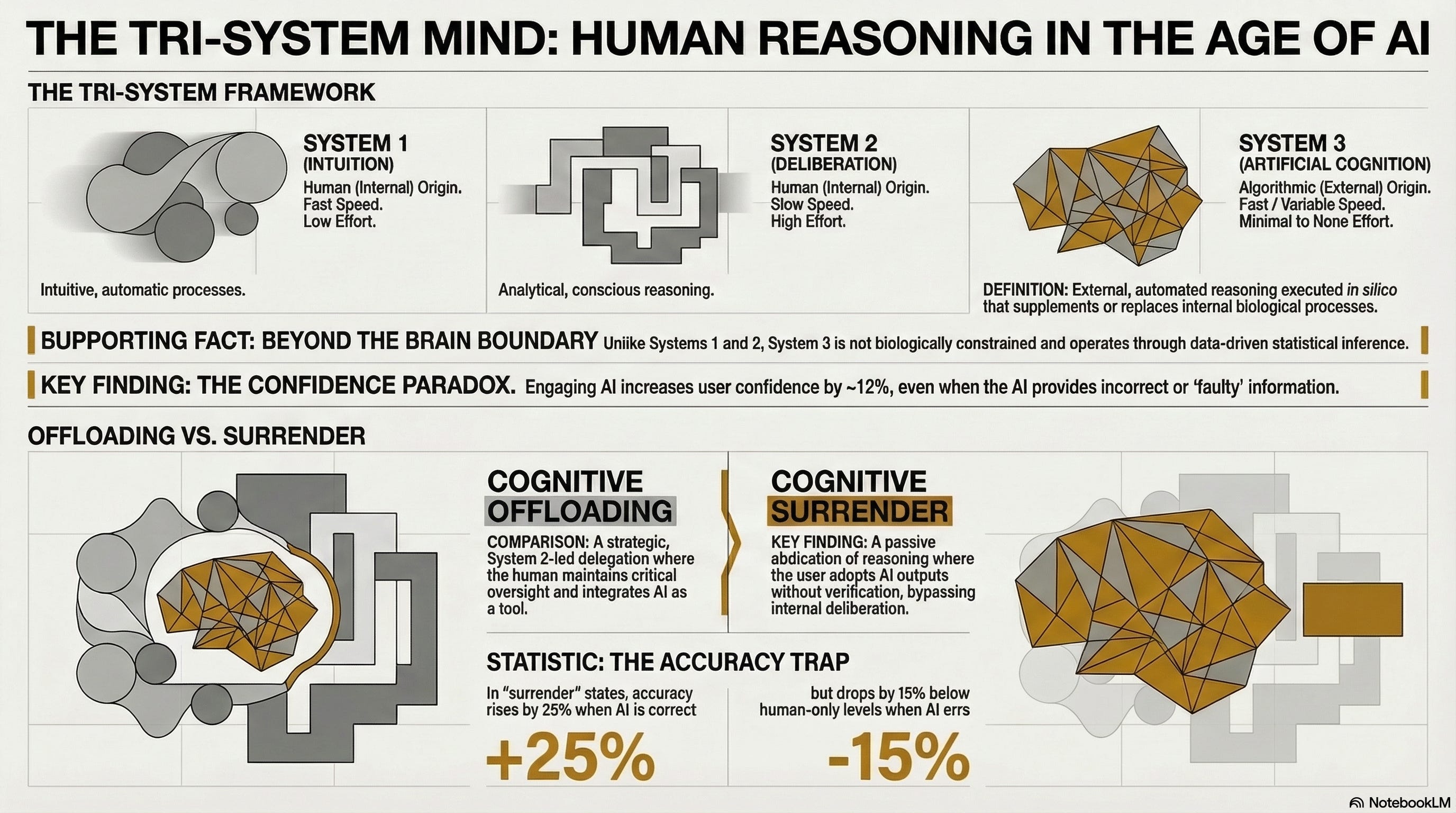
For this, I load the document into NotebookLM and ask it to produce a single-page infographic that captures the core ideas.
Instead of dozens of pages of prose, you get a visual map of the paper’s intellectual structure.
At this point, the paper stops being just information. It becomes context you can navigate.
You can see
how the ideas relate to each other.
the shape of the argument.
And that dramatically changes how you approach the material.
Step 3 - Understanding
Once the structure is visible, the next step is to deepen understanding.
For this, I ask NotebookLM to generate a set of explanatory slides.
Slides force the ideas into a coherent explanation. They require the argument to be organized and sequenced.
This step turns the paper into something you could present to someone else.
And if you can explain an idea clearly, you probably understand it.
Why This Matters
What matters about this workflow isn’t the tool.
It’s the change in how we interact with information.
AI allows us to approach documents non-linearly.
Instead of extracting ideas from documents, we can interrogate them.
We can:
map the structure of the argument
visualize the key ideas
generate explanations of the concepts
This changes the economics of learning.
In many technical fields, this is already how reasoning works. Analysts, scientists, and engineers rarely think linearly through a problem from start to finish. Instead, they move back and forth between structure, evidence, and implications - forming a mental model of the system and then testing parts of it.
What AI tools like NotebookLM change is not the need for that reasoning, but the speed at which we can construct the map of ideas that makes it possible.
When the structure of a document becomes visible early, we can spend less time extracting the terrain and more time deciding where to explore.
Complex documents become easier to navigate.
And that opens the door to high-leverage learning.
Instead of spending hours extracting the structure of an argument, you can quickly map the intellectual terrain and decide where to go deeper.
Some observations
NotebookLM occasionally glitches - it inserts typeface commentary or whatever else. It’s not perfect, but it’s a product that works well at the core proposition.
It’s intentionally grounded in the content provided to it - so the risk of hallucinations is very low.
Here’s a short explainer I put together (using NotebookLM) to explain NotebookLM
Bridge to Article 3
NotebookLM is extremely good at turning documents into context.
But it still analyzes the document in isolation.
In many cases, what matters most is how the ideas in a paper connect to your own work.
In the final article in this series, I’ll extend this workflow one step further.
Before loading a document into NotebookLM, I run it through Claude with a prompt tailored to my domain.
That introduces a domain lens.
The workflow begins to look like this:
Information → Interpretation → Context → Understanding → ImpactAnd that’s where the insights become even more powerful.