

After playing Wordle 1,214 times, certain things stop feeling accidental.
The answer is never plural. Some letters matter far more than others. And words that feel clever often turn out to be useless. These aren’t strategies you learn from a guide: they’re patterns you internalize through repetition.
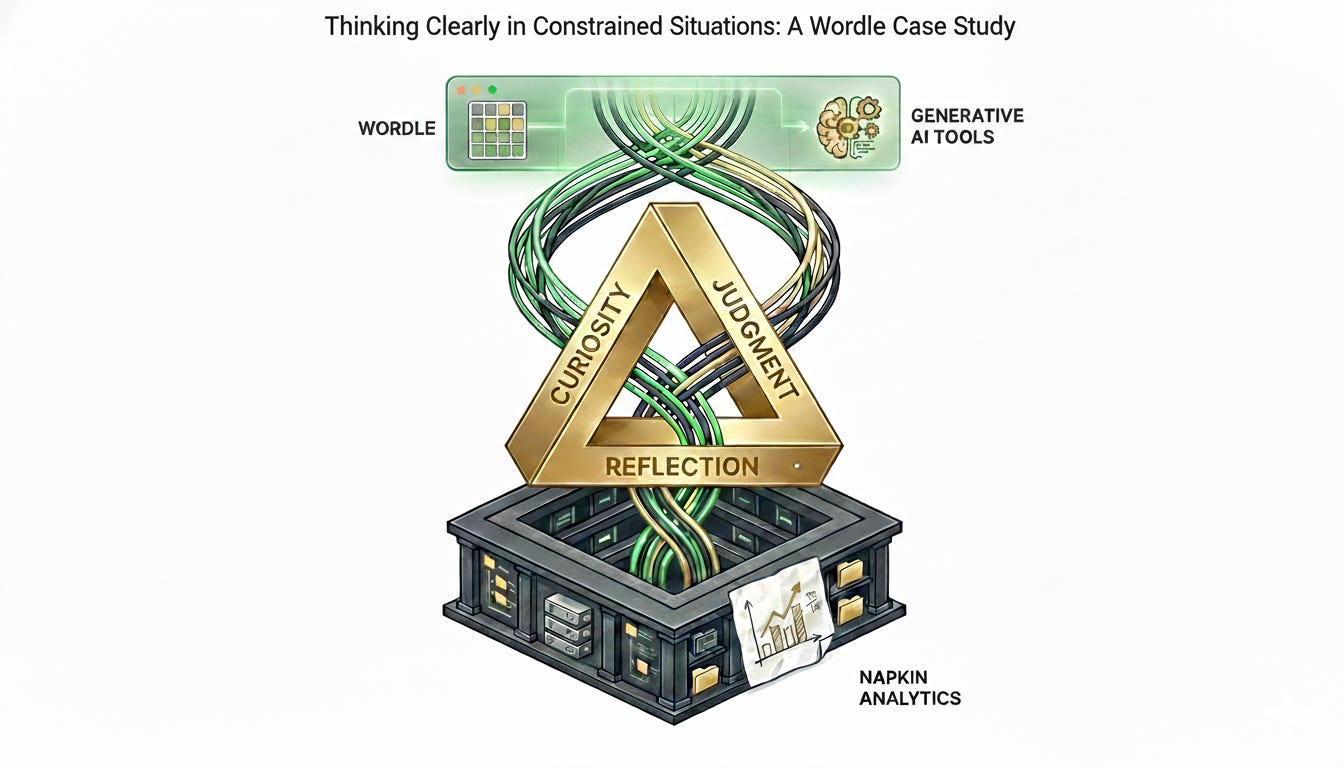
That’s exactly where Napkin Analytics is a great starting point.
Not with proof. Not with completeness. But with a quiet sense that something is reliably true, even if you can’t yet explain why.
The interesting question isn’t whether these patterns exist. It’s why they do.
Wordle presents itself as a simple word puzzle, but it isn’t a free-form language game. It’s a carefully constrained system. The rules are minimal. The solution space is bounded. And yet there’s just enough ambiguity to make each guess feel consequential.
Those constraints do most of the work.
They explain why broad letter coverage beats novelty, why intuition develops quickly, and why you can often sense a bad guess before you can articulate what’s wrong with it. You’re not solving an English problem so much as learning the shape of the system.
Napkin analytics works the same way. Before you draw a floor plan, you feel the walls.
You probe the space. You learn where the boundaries are. You get an early sense of what moves are possible and which ones lead nowhere. That sense isn’t precise, but it is directional. It gives you a working version of the answer, even before you’ve done any detailed analysis.
That provisional sketch matters.
As you work through deeper analysis, you carry that early mental model with you. It tells you roughly where you expect to land. And if the final answer ends up looking very different, that’s a signal. Either your initial hypothesis was wrong — which happens — or the path you took through the analysis led you astray.
Both are worth investigating.
Wordle behaves the same way. Early guesses don’t solve the puzzle, but they establish expectations. When a later guess behaves very differently from what you anticipated, you don’t ignore it. You stop and ask why. That feedback loop is the point.
Once you start looking for them, the constraints are hard to unsee. Grammar is flattened. Inflection disappears. Familiar words are favored over obscure ones. Ambiguity exists, but only in specific, controlled forms. The puzzle gives you freedom, but only inside clearly defined boundaries.
That balance is what makes the system learnable. And it’s what makes intuition reliable.
You don’t need to calculate much to feel this. You just need to play — and pay attention.
Sidebar: Constrained doesn’t mean shallow
By “constrained,” I don’t mean rigid or limiting. I mean that the shape of the system defines what questions are even possible, long before you start reasoning inside it.
That doesn’t mean there aren’t rich questions to ask. In fact, well-designed constraints are what make rich questions possible. They narrow the space enough that exploration is productive, not overwhelming.
The trick (and this is where judgment comes in) is knowing which concepts actually apply, and which ones are technically valid but not meaningful.
“Queue” is a perfectly valid Wordle word. It follows every rule. But it’s a poor opening guess because it doesn’t meaningfully reduce uncertainty. Too many repeated letters. Too little signal.
Analytics works the same way. Many questions are valid within a schema. Far fewer are useful. The work isn’t just knowing what you can ask. Instead, it’s recognizing which questions are worth asking at all.
Constraints define the space. Judgment determines how you move within it.
Seen this way, Wordle stops being about vocabulary and starts being about reasoning under constraint.
That’s the core of napkin analytics:
learning the shape of a problem quickly enough to act intelligently
keeping a provisional answer in mind
being willing to revisit both the hypothesis and the analysis when reality disagrees.
The next step is to make those constraints explicit — and see just how deliberate they really are.
My next post will examine this.