

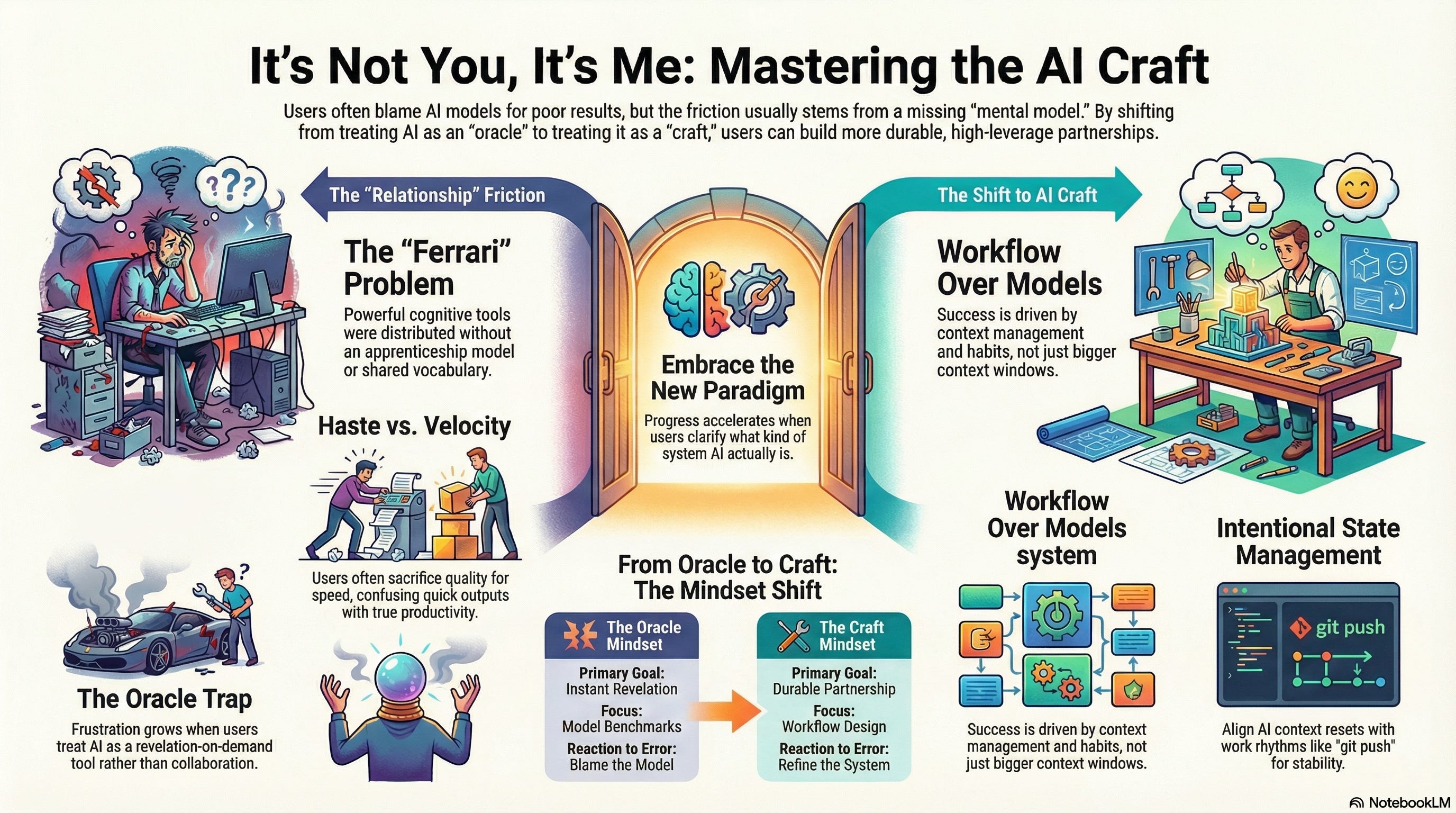
Let’s be honest with each other.
You’ve been in this relationship for a while now. Things started electric. The possibilities felt endless.
And then — somewhere along the way — sessions started going sideways.
The outputs aren’t what you expected. Context drifts. You switch models mid-project, convinced the next one will finally get you. You start wondering whether you’re just not compatible.
I’m here to tell you: it’s not you.
Actually, it is a little bit you.
And that’s good news. Because that means there’s leverage.
Maybe you’ve tried couples therapy. A different model, a better prompt, a longer context window. You’ve read the think pieces. You’ve watched the demos. And still, some days, it feels like you’re doing all the work while your partner just… hallucinates confidently in the wrong direction.
Here’s what I’ve learned: the relationship isn’t just salvageable. With the right work — the right habits, the right mental models, the right moments of honest self-examination — it can become something genuinely beautiful and enduring. A partnership that makes you measurably better at the work that matters to you.
But it starts, as it always does, with looking at your own behavior first.
We Handed Everyone a Ferrari and Skipped the Lessons
We’ve given people some of the most powerful cognitive tools in human history. And almost no guidance on how to use them well.
No apprenticeship model.
No shared craft vocabulary.
No institutional memory.
The onboarding is “here’s the chatbox. Good luck.”
So everyone is improvising, mostly in private.
The result?
Sacrificing quality for speed, confusing haste with velocity.
Bad habits that feel like productivity.
Workarounds that masquerade as systems.
Frustrations blamed on the model when the friction is actually in the workflow.
It’s not incompetence. It’s a missing mental model.
We have remarkably few durable examples of what “good” looks like in real, day-to-day work. The few that exist are scattered across research threads, buried in developer forums, or abstracted into thought leadership that’s long on vision and short on “here’s what I actually do on a Tuesday afternoon.”
I’m writing this as someone who builds daily with and within AI systems — not as a commentator, but as a practitioner whose work depends on getting this right.
That gap — between capability and craft — is what this series is about.
I’ve Led Through Transitions Like This
For most of my career, I’ve worked at the seam between new technology and the people who have to use it. Not selling tools, but shaping how teams think inside new paradigms. Designing the mental models that let people cross over safely — and productively.
When event-driven Windows programming arrived, I helped COBOL programmers reframe what was happening — the logic hadn’t disappeared, it had changed shape.
When relational databases took hold, I guided administrators through the shift from procedural control to declarative leverage. Not less power, but a different kind.
When the web went stateless, I helped developers rethink their approach from implicit continuity to explicit state management.
When microservices fragmented monoliths, I pushed organizations to treat data hygiene as critical rather than casual.
When repo-based workflows came to analysts, I helped teams absorb the short-term dip in velocity and build systems in which quality became load-bearing — until speed returned, stronger than before.
After decades of guiding teams through shifts like this, I can tell you they follow a pattern:
A new paradigm arrives.
Old instincts start failing.
Friction gets mistaken for incompetence.
Progress accelerates when someone clarifies what kind of system this actually is.
Craft emerges — and spreads.
AI is that moment again. Bigger stakes, faster pace, but the same shape.
I’m not studying it from the sidelines. I’m building inside it daily — refining workflows that hold up under real pressure. And I don’t think that knowledge should stay isolated.
That’s what this series is: the reverse-engineering. Practical things I’ve learned, tested, and actually use — shared in enough detail to be genuinely useful, not just inspirational.
What This Series Is (And Isn’t)
This is not about ethics, model benchmarks, existential risk, or the newest shiny thing.
It’s about the discipline of working with AI well:
The habits.
The workflow design.
The context management.
The moments where you intervene instead of blame.
Each piece will be grounded in real situations — actual projects, not hypotheticals. Sometimes technical. Always honest.
We’re keeping the relationship metaphor because it’s not just cute — it’s accurate. Bad AI sessions look suspiciously like bad relationships: blame, avoidance, magical thinking about fresh starts.
Most frustration with AI comes from treating it like an oracle — something that should produce revelation on demand. But durable results come from treating it like a craft — something you design, discipline, and improve.
The First Real Piece: Context Decay
Next up: why your AI sessions degrade over time — and what to do about it. (Link Here)
Spoiler: it’s not fixed by switching models or buying a larger context window. That’s the equivalent of moving to a nicer apartment and assuming the relationship will improve.
The solution is structural. It has to do with how you manage state, how you externalize decisions, and how often you deliberately reset rather than push through noise. I’ll walk through a workflow that ties context management to your git push rhythm in a way that’s surprisingly low-friction and materially stabilizing.
This shift is happening whether we participate consciously or not.
We can treat AI as a hallucinating oracle, or we can treat it as a craft — something we design, discipline, and improve.
I’m choosing craft. If you are too, subscribe.
Not hype. Not mysticism.
Practice.
It’s Not You, It’s Me is a series about the craft of AI-assisted work — practical, honest, and occasionally self-aware about the absurdity of all of this. New pieces drop about once a week. If something resonates or you’ve solved a problem differently, I’d love to hear about it: substack@dhk.io