

How do I balance exercise time with networking?
Yesterday, during a Peloton class, I drafted two high-stakes fundraising email templates.
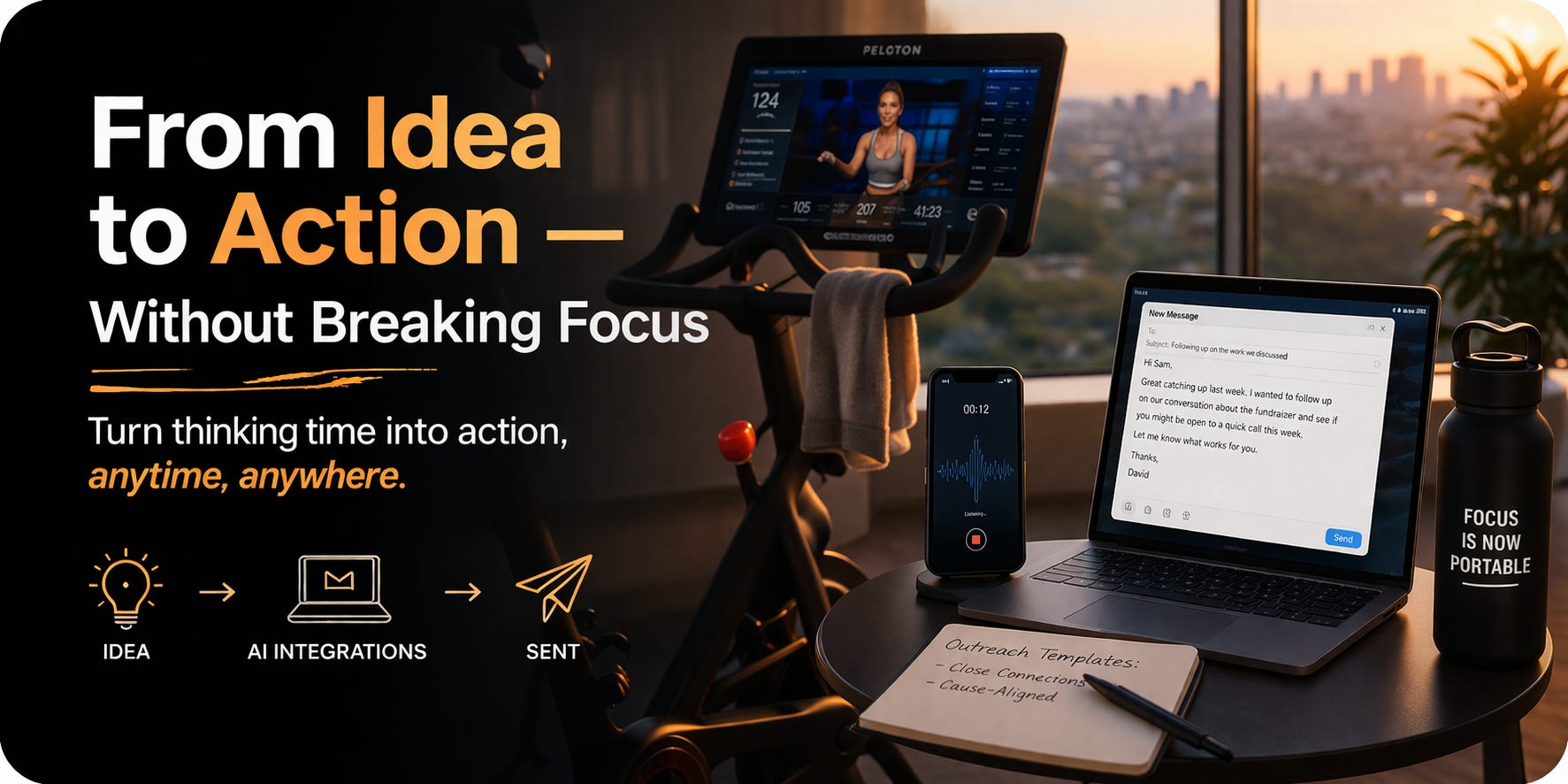
This isn’t cutting corners. It’s making focus time portable. Ideas matter. Action is what matters.
I was six feet from my laptop and six inches from my phone. I was talking and thinking, not worrying about formatting or typos. The ideas were mine, the voice was mine, and the tooling just removes the friction between the thought and the sent email.
That’s the distinction I want to draw: it wasn’t about outreach volume. Instead: outreach quality at velocity.
My goal was thoughtful, targeted outreach to the right people, in my actual voice, with an authentic ask, and done easily enough that I actually follow through instead of putting it off.
The Conversation (Condensed)
I opened Claude on my phone and talked through what I wanted: outreach templates for some non-profit fundraising I’m leading: one version for people I know well, another for people I know less well but who have a connection to the cause.
Claude asked a few clarifying questions, such as relationship, timetable, and call-to-action; and then drafted both. We refined the hook, sharpened the distinction between the two, and packaged both into a single email to ask two contacts for their feedback.
Claude found both email addresses in my Gmail history, confirmed one I wasn’t sure about, and then put the drafts in my inbox ready to send.
Total elapsed time: one Peloton warm-up (12 minutes!)
Here’s How I Made It Work, and How You Can Too
The reason this worked isn’t the AI. It’s the integration.
Claude was plugged into my Gmail. That means no tab-switching, no copy-pasting, no looking up email addresses. I stayed in thinking mode the entire time. The tooling handled the operational layer.
That matters, not because you should be sending more messages, but because you should be sending better ones without them taking half your afternoon. The goal is high-quality, human outreach that actually sounds like you, delivered with enough consistency for it to compound.
Three things to try:
Connect your AI to your email. Claude and others support this now. It changes the workflow entirely.
Draft conversationally. Talk through what you want to say. Refine it like a conversation, not a document.
Use focus time differently. A walk, a workout, or a commute can all be thinking time, and with the right setup, thinking time becomes working time.
The goal isn’t to automate your relationships; instead, it’s to remove the friction so you actually show up for them.
Want to See This in Action?
I’m putting together a small working session, office-hours-style, where I’ll walk through exactly how I set this up and show you how to do it, too.
If you’d like to be included, send an email to qualityAI@dhk.io, and I’ll get you the details.