

Part of an ongoing series: It’s Not You, It’s Me
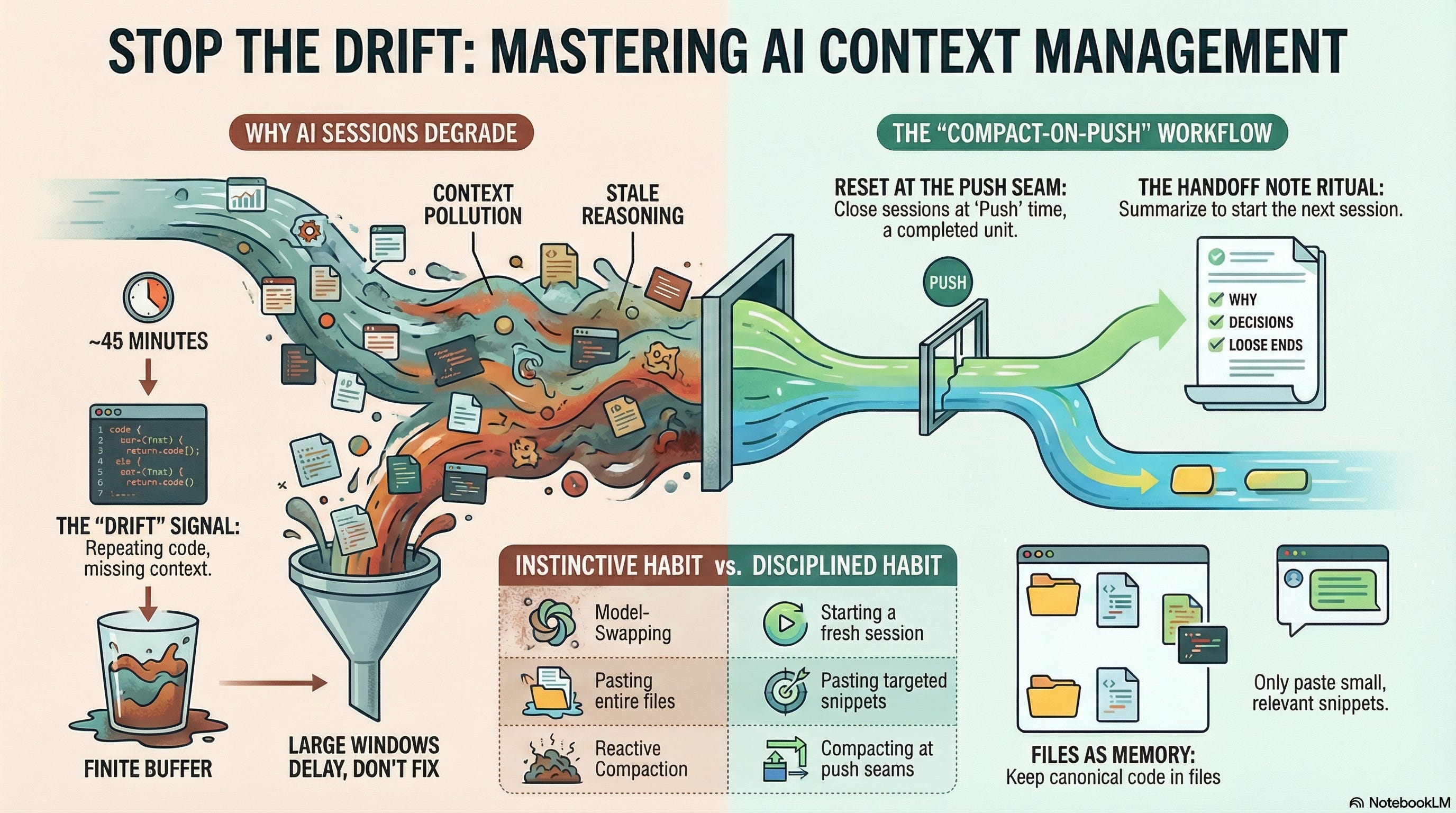
Here’s a pattern in AI-assisted development that most people don’t recognize until it’s too late: the session that slowly gets worse.
You start sharp. The first few exchanges are tight, useful, and on-point. Then, somewhere around the 45-minute mark, things drift. The model repeats itself. It misses something obvious. You paste more context in an attempt to correct it, which makes things worse.
By the end, you’re arguing with the tool.
That right there is the signal. You have a system capable of synthesizing large amounts of context, and you’ve driven it into confusion. And you’re arguing. With a tool.
Once people recognize this pattern, they usually misdiagnose it — treating it as a failure of the tool.
The model got worse.
Something broke.
This one just isn’t as good.
That’s the wrong diagnosis.
This isn’t a model problem. It’s a context management failure — a consequence of how the session is being run.
The good news: it’s fixable. And the fix is structural.
If you want to understand exactly what’s happening inside the model when a session degrades — the token mechanics, why signal collapses, why more context makes things worse — I’ve written a companion explainer: Why Your AI Sessions Degrade — And What’s Actually Happening. This piece focuses on what to do about it.
The Bad Patterns We Reach For
Before getting to the fix, it’s worth naming the instinctive responses — because they feel productive, and they make the problem worse.
Model-swapping
Things go sideways, so you switch models. Try the other one. Maybe it handles this better.
Sometimes legitimate — models do have different strengths. But as a response to context degradation, model-swapping is a trap. You’re not fixing the problem. You’re evacuating it.
The new model has no history, no established reasoning, none of the nuance you built up. You’re starting over and calling it progress.
Worse, it trains the wrong reflex: when output degrades, reach for a different model. The right reflex is to look at what you brought into the session.
Reaching for a larger context window
If context is the constraint, get more of it. Switch to a model with a larger window.
This doesn’t fix the problem. It delays it — and you’re paying more to make bad habits more comfortable.
The discipline isn’t finding a bigger container. It’s keeping the container clean.
Why the Obvious Alternatives Fall Short
Starting fresh works, but resets continuity. Mid-debug, you’re reconstructing reasoning you already had.
Compacting reactively — waiting until things break, then scrambling — is the worst possible moment to do it. You lose nuance and drop critical context exactly when you need it most.
Modular file management — keeping canonical code in files, sharing snippets not full files — is table stakes, but it doesn’t solve session-level drift on its own.
None of these actually solves the problem.
The Insight: It’s Not One Session — It’s Phases
Thinking about this as a single “session” is misleading.
A typical working block contains multiple phases: exploring the problem, debugging a specific issue, refactoring, and validating outputs. Each has its own context, its own reasoning, its own working set.
The key insight: structure your workflow around phases, not sessions.
At each phase boundary:
push → compact → scope → restart clean
This is already how experienced practitioners work implicitly. The difference is in doing it deliberately. Once you do, context management stops being reactive and becomes part of your system.
Why Push Is the Right Seam
Commit-level is too frequent. A commit is a checkpoint, not a true boundary.
Push-level aligns with phases. A push represents a complete unit of intent — something finished enough to share. You’re already pausing: reviewing the diff, writing the push message, deciding what comes next.
That pause is your phase boundary. At that moment, the work is coherent, the reasoning is fresh, and the context can be cleanly summarized. You’re not interrupting flow. You’re formalizing it.
The Workflow
At each phase boundary (push time), instruct the model to generate a structured handoff note:
Generate a structured handoff note for this phase of work. Include:
What was built or changed (functional summary)
Why — key decisions and tradeoffs
Loose ends — unfinished or deferred work
Gotchas — constraints, quirks, or pitfalls
Suggested next step for the next phase
This becomes the opening message of your next phase. No re-explaining. Just a clean brief.
Your push message does double duty. If you’re already writing disciplined push messages, you’re halfway there. Design them to serve both purposes: the diff explains what, the handoff explains why. One artifact, two jobs.
Over time, these handoffs compound. They don’t just help you — they create a trail that others can follow, extend, and build on. That’s the leverage.
Here’s an example skill you can use to help with this process.
Guidelines for Structuring Your Workflow
1. One phase, one goal. “Debug the join logic” — not “work on the pipeline.”
2. Files are memory. Chat is reasoning. Keep canonical code in files. Share snippets. Reference by name. Never paste the same thing twice.
3. Compact at phase boundaries, not reactively. Finish the unit of work first. Mid-task compaction drops exactly the context you still need.
4. Write the handoff before you push. Make it part of the ritual. Five minutes now saves fifteen later.
5. The handoff note is the artifact. Code captures implementation. The handoff captures reasoning. Both matter.
6. Watch for drift signals. Repetition. Missed context. Off-target suggestions. That’s the signal — not a cue to paste more. It’s a cue to close the phase.
The Meta-Principle
Context management is workflow design.
The practitioners who get the most out of AI-assisted work aren’t the ones with the biggest context windows — they’re the ones who structure their work into coherent phases and manage transitions deliberately.
Compact on your schedule. At your phase boundaries. With intention.
Push is the seam. Use it.
The tool isn’t degrading. Your session is. Design it accordingly.
It’s Not You, It’s Me is a series about practitioner discipline in AI-assisted work — the habits, workflows, and mental models that separate people who use AI well from people who just use AI. If you’re building analytics workflows with AI assistance and want to compare notes, reply or drop a comment.