
Consumer-grade tools. Industrial-grade reach. Civilian-grade judgment.
The three levers that changed what AI can do — you set the limits; you own the outcome.

Earlier this week, I published two pieces(1, 2) on how AI tools can act on our behalf.
They weren’t just how-to posts. They’re an example of an important structural shift, one worth naming and exploring directly.
The old constraint
For most of software history, the behavior of a system was limited by the imagination of the programmers who built it.
If you didn’t like how it worked, you needed a programmer to change it. If you wanted it to connect to another tool, the same answer applies. If you wanted it to act on your behalf in the world, to send that email, create that task, update that calendar, you needed someone to build that capability for you.
The constraint wasn’t your imagination. It was someone else’s.
The new constraint
That has changed. Quietly, and faster than most people realize.
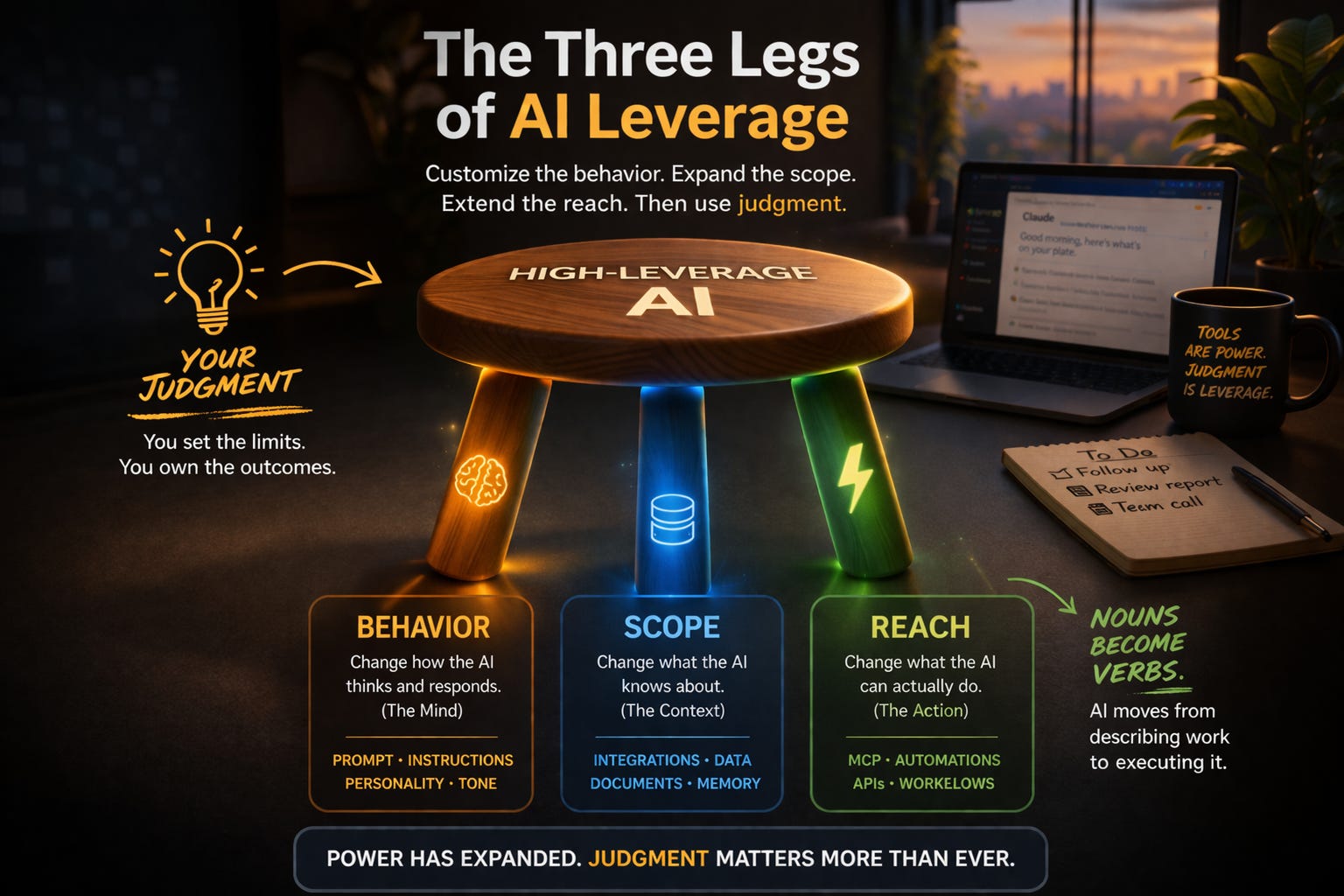
AI systems can now be customized by anyone, not just developers or IT, along three dimensions. I think of them as legs of a stool.
Leg one: Behavior. A prompt changes how the AI thinks, responds, and prioritizes. Anyone can write a system prompt and fundamentally reshape how an AI operates. Previously the domain of engineers, it’s now yours.
Leg two: Scope. An integration changes what the AI knows about. Connect your calendar, your tasks, your documents, and the AI operates with your context, not just its training. It can see your world.
Leg three: Reach. MCP, which stands for Model Context Protocol, changes what the AI can actually do. Not just describe things, not just draft things, but act on things; send the email, add the task, create the event. AI moves from describing work to executing it. “The noun becomes a verb.
The part nobody’s talking about
Consumer-grade tools. Industrial-grade reach. Civilian-grade judgment.
That gap, between what these tools can now do and the wisdom required to use them well, is the central challenge of this moment.
A great deal of professional value has always come from judgment. Judgment comes from experience. Experience comes from surviving bad decisions and learning from them. That formation takes time, and it doesn’t transfer automatically to someone who just downloaded an app.
Most people picking up these tools right now don’t have them yet. They have access to industrial-grade reach, but they’re operating on instinct, enthusiasm, and the assumption that the AI will somehow know where the limits are.
It won’t. That’s your job.
I’m not saying don’t use the tools; I use them every day. I’m saying the stool has three legs, but the person sitting on it is still responsible for not falling off.
Previously, programmers set the limits of what was possible. Now you’ve set the limits, so the question is no longer what can this system can do?
The question is: what should I do with it, and am I wise enough to know the difference?
That is not a technical question. It is a human one.
And it is now yours to answer.
This is part of an ongoing series on building a high-leverage relationship with AI. If it’s useful to you, subscribe and follow along.